News
Amazon Bedrock AgentCore Adds Three New Layers of Agent Knowledge
Amazon Web Services is framing its latest Amazon Bedrock AgentCore updates around three new layers of agent knowledge: organizational knowledge, world knowledge and paid knowledge.
The company detailed the additions in a June 17 post, "New in Amazon Bedrock AgentCore: Build agents with broader knowledge and continuous learning," published around AWS Summit New York. The updates are aimed at helping agents connect to internal enterprise content, live web information and paid data sources, while adding feedback and governance capabilities for production deployments.
The knowledge-layer framing marks the main focus of the Bedrock AgentCore announcements. AWS said the new capabilities are intended to address gaps that can limit agent usefulness in production: access to the right context, access to resources beyond free or internal sources, and feedback loops that show whether agents are improving after deployment.
Three Layers of Agent Knowledge
The first layer is organizational knowledge, represented by Amazon Bedrock Managed Knowledge Base. AWS said the managed capability is designed to connect agents to enterprise data spread across sources such as SharePoint, Google Drive, Confluence, Amazon S3 and internal wikis.
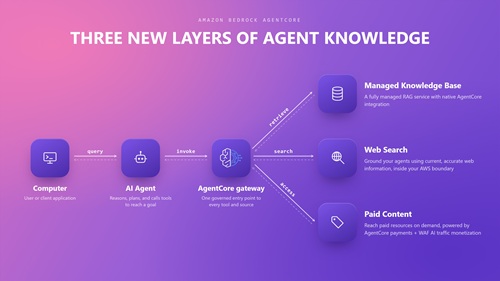 [Click on image for larger view.] Three New Layers (source: AWS).
Managed Knowledge Base replaces custom ingestion and retrieval-augmented generation pipeline work with a managed service that handles vector storage, embeddings, re-ranking, retrieval and scaling concerns. AWS said it also includes an agentic retriever that can plan queries across knowledge bases, connect related concepts across documents, evaluate intermediate results and re-rank results before answering.
For developers, the feature is available as a pre-built target type in Amazon Bedrock AgentCore Gateway. AWS said the gateway integration can expose knowledge base tools through the Model Context Protocol, allowing compatible clients and frameworks to discover them without custom integration code.
The second layer is world knowledge, represented by Web Search on Amazon Bedrock AgentCore. AWS said the tool gives developers a way to ground agents in current web information while keeping queries within the customer's AWS security and compliance boundary.
According to AWS, Web Search is built on Amazon search infrastructure and combines public web information with Amazon's knowledge graph. The company positioned it for agents used in research, fact-checking, customer service, regulatory monitoring and market intelligence, where model training data alone may be outdated or incomplete.
The third layer is paid knowledge, involving AgentCore payments and AWS WAF AI traffic monetization. AgentCore payments, available in preview, is designed to let agents discover, access and pay for paid services and content inside the agent execution loop. AWS WAF AI traffic monetization, now generally available, is designed for content owners, allowing them to block, allow or monetize agent access.
AWS said the combination creates a channel for verified agents to access premium resources while giving content owners a way to control and receive compensation for agent traffic. The examples cited by AWS include financial market feeds, licensed research, proprietary datasets and premium application programming interfaces.
AgentCore Adds Feedback for Production Agents
Beyond the three knowledge layers, AWS also announced optimization capabilities intended to help teams evaluate and improve production agents after deployment.
Failure, intent and trajectory insights are available in preview. AWS said failure insights are designed to identify recurring failure patterns, including behavioral failures that may not appear as application errors. Intent insights group requests by what users were trying to do, while trajectory insights group the paths agents take through tasks.
Recommendations and A/B testing are generally available. AWS said recommendations analyze traces and evaluation outputs to suggest changes to system prompts and tool descriptions. Batch evaluation can then test those recommendations against a defined dataset, while A/B testing compares agent versions by splitting live production traffic.
AWS said these optimization capabilities work whether agents run on AgentCore runtime, AWS Lambda, Amazon Elastic Kubernetes Service or non-AWS environments.
Guardrails Move to the Gateway Layer
AWS also announced generally available Bedrock Guardrails integration for AgentCore policies. The integration evaluates agent actions for prompt injection attempts, harmful content and sensitive data exposure at the gateway layer, outside the agent's code.
According to AWS, the AgentCore policy engine makes deterministic allow-or-deny decisions based on established thresholds. AWS also said AgentCore will support detection signals from security providers including Check Point, Zscaler, Rubrik, Netskope and SentinelOne.
The gateway-based model is intended to apply the same policy controls across tools and context sources routed through AgentCore Gateway, including organizational knowledge, web search and paid services.
Harness Reaches General Availability
AWS also said AgentCore Harness is now generally available. AWSInsider previously covered the AgentCore Harness general availability announcement, so it is summarized here as part of the broader AgentCore update.
AgentCore Harness is a managed capability that runs the agent orchestration loop, executes tools, manages context, persists state across turns, recovers from failures and isolates sessions. Developers define the model, tools, skills and instructions in configuration, and AgentCore assembles and runs the loop.
AWS said the harness includes a filesystem and shell, memory across sessions, skills including an AWS-curated catalog, and web browsing. The company also said the harness is decoupled from any single model provider, allowing developers to switch models without changing agent logic.
The combined announcements put more managed functionality around Amazon Bedrock AgentCore. The three knowledge layers address what agents can reach. The optimization features address how agents are evaluated and improved. The Guardrails integration addresses policy enforcement as agents gain access to more tools and context. The Harness general availability adds a managed execution layer for running agents on the same platform.
AWS said Managed Harness, Bedrock Managed Knowledge Base, Web Search, Guardrails integration, recommendations and A/B testing are generally available. Insights and payments are available in preview.
About the Author
David Ramel is an editor and writer at Converge 360.