News
Amazon Bedrock AgentCore Now Generally Available for Building and Scaling AI Agents
Amazon Web Services (AWS) has announced the general availability of Amazon Bedrock AgentCore, a platform for building, deploying, and managing production-scale AI agents using any framework, model, or protocol. The launch expands AWS's agentic AI capabilities within Amazon Bedrock, giving developers a modular and secure foundation for enterprise-scale agent operations.
 [Click on image for larger view.] Amazon Bedrock AgentCore (source: AWS).
According to the compmany's blog post earlier this month, AgentCore provides a set of composable services--Runtime, Gateway, Memory, Browser, Code Interpreter, Identity, and Observability--that can be used independently or together. With this release, all services now support Virtual Private Cloud (VPC), AWS PrivateLink, AWS CloudFormation, and resource tagging. The Runtime component extends its preview capabilities with eight-hour execution windows and complete session isolation, while introducing Agent-to-Agent (A2A) protocol support for direct communication between agents. Gateway connects to existing Model Context Protocol (MCP) servers and can transform APIs or AWS Lambda functions into agent-compatible tools. It also adds IAM authorization alongside OAuth for secure agent-to-tool interactions. The Observability service integrates with Amazon CloudWatch and supports OpenTelemetry for external monitoring tools such as Datadog, LangSmith, and Langfuse.
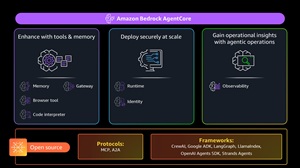 [Click on image for larger view.] Amazon Bedrock AgentCore Highlights (source: AWS).
Developers can begin building with the open source AgentCore Starter Toolkit, available under the Apache 2.0 license. The toolkit includes a command-line interface (CLI) for deploying AI agents to Bedrock AgentCore with zero infrastructure management, along with prebuilt integrations for Gateway and Memory. It supports open frameworks such as LangGraph, CrewAI, Strands Agents, and LlamaIndex, enabling migration or composition of agents across environments. Each modular service--Runtime, Memory, Gateway, Browser, Code Interpreter, Identity, and Observability--has its own quick-start guide and can be combined for full-lifecycle control from execution to observability.
AgentCore uses consumption-based pricing with no upfront fees or commitments. Each service is billed separately based on CPU and memory usage, calculated per second, and excludes CPU charges during I/O wait periods. Beginning Nov. 1, 2025, AWS will apply standard EC2 network transfer rates for Runtime, Gateway, Code Interpreter, and Browser services. A cost example provided by AWS estimates that a customer support agent handling 10 million monthly user requests could operate for about $7,625, depending on session duration and workload mix.
To support developers, AWS has published a centralized AgentCore Resources page with videos, blog posts, and implementation guides. A deep-dive walkthrough led by AWS Developer Advocate Mike Chambers demonstrates how to deploy, enhance, and monitor agents in production. Additional resources include a curated playlist of customer stories and technical demos showing AgentCore in real-world use. Amazon Bedrock AgentCore is now available in nine AWS Regions across North America, Europe, and Asia-Pacific. Developers can explore pricing details at AgentCore pricing or visit the samples GitHub repository for examples. There's also the onboarding repo.
About the Author
David Ramel is an editor and writer at Converge 360.