News
AWS Broadens Agentic AI Across Cloud and Data
Amazon Web Services (AWS) is expanding its agentic AI capabilities across both the data and application layers, combining new natural language tools for Amazon S3 with the launch of Amazon Quick Suite, an integrated workspace for research, analytics, and automation. Together, the two initiatives highlight AWS's push to make conversational, reasoning-driven AI a core feature across its ecosystem.
In today's AWS Storage Blog post, the company detailed how conversational AI can be used to derive insights from Amazon S3 metadata. The approach integrates Amazon Q with the Model Context Protocol (MCP) Server for S3 Tables, enabling users to interact with stored data through natural language. Developers can issue queries, explore object metadata, and automate data management tasks without writing code. AWS said this capability allows users to "ask natural language questions about their S3 data and metadata" while maintaining full control within their own environment.
"Amazon S3 Metadata, combined with the MCP Server for Amazon S3 Tables, provides a comprehensive solution for automated data discovery and intelligent interaction with your data," the company said. "This integration automatically captures and organizes metadata while enabling natural language interactions with your datasets, eliminating the need for specialized query language expertise. The solution leverages Amazon Q Developer for CLI as a conversational interface, making data exploration accessible to users across all technical skill levels."
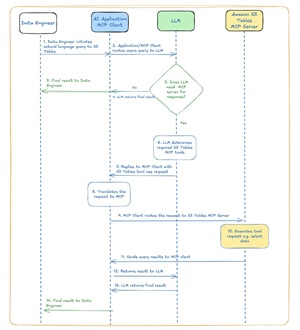 [Click on image for larger view.] How the Interactions Happen Behind the Scenes (source: AWS).
Use cases for the integration initiative were listed as:
- Creating and managing table buckets and namespaces
- Defining and modifying table schema
- Importing data from various sources
- Querying data using SQL
- Appending and updating records
The integration demonstrates how agentic AI can function directly at the data layer, turning storage metadata into a conversational interface for exploration and operational insight. It also shows how AWS is positioning Amazon Q as the intelligence layer across its cloud services.
And, last week, AWS announced Amazon Quick Suite, a unified platform designed to act as an "agentic teammate" that answers questions and takes actions on behalf of users. Quick Suite combines four AWS services--Quick Research, Quick Sight, Quick Flows, and Quick Automate--into a single workspace where users can analyze data, visualize results, and automate workflows using natural language commands.
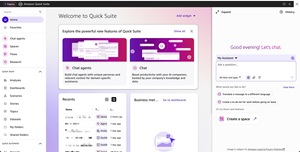 [Click on image for larger view.] Amazon Quick Suite (source: AWS).
AWS described the platform as "your agentic teammate that quickly answers your questions at work and turns those insights into actions for you". The suite is powered by Amazon Q and designed to help users move from data discovery to decision-making without switching tools or writing scripts.
The company said Quick Suite includes the following integrated capabilities:
- Research -- Quick Research accelerates complex research by combining enterprise knowledge, premium third-party data, and data from the internet for more comprehensive insights.
- Business intelligence -- Quick Sight provides AI-powered business intelligence capabilities that transform data into actionable insights through natural language queries and interactive visualizations, helping everyone make faster decisions and achieve better business outcomes.
- Automation -- Quick Flows and Quick Automate help users and technical teams to automate any business process from simple, routine tasks to complex multi-department workflows, enabling faster execution and reducing manual work across the organization.
Viewed together, the two announcements show how AWS is extending its agentic AI vision from infrastructure to productivity. The S3 conversational interface exemplifies how agentic systems can understand and reason over cloud data, while Quick Suite applies the same concept to enterprise collaboration and business intelligence. Both rely on Amazon Q to bridge conversational input with operational execution.
By embedding conversational, context-aware agents across its stack, AWS is moving toward an ecosystem where AI not only interprets information but also acts on it, linking cloud data and enterprise workflows through a single agentic framework.
About the Author
David Ramel is an editor and writer at Converge 360.