News
AWS Takes the Ops Out of EC2 Container Hosting
Amazon Web Services (AWS) has added a new managed compute option that brings EC2 power to container infrastructure--minus the hands-on hassle.
Amazon ECS Managed Instances let users run container workloads on the full range of EC2 instances while AWS takes care of provisioning, scaling, patching, and maintenance. The service combines EC2's flexibility with Fargate's ease of use, streamlining container deployment, reducing operational overhead, and optimizing costs. Fargate is the serverless compute engine for Amazon ECS that runs containers without requiring users to manage virtual machines.
With ECS Managed Instances, users can choose from any EC2 instance type--including GPUs and ARM-based options--while AWS automates the infrastructure behind the scenes. The result, AWS indicated, is an environment that delivers EC2-level performance and customization without the burden of managing the servers themselves.
"This new offering combines the operational simplicity of offloading infrastructure with the flexibility and control of Amazon EC2, which means customers can focus on building applications that drive innovation, while reducing total cost of ownership (TCO) and maintaining AWS best practices," the company said in a Sept. 30 announcement.
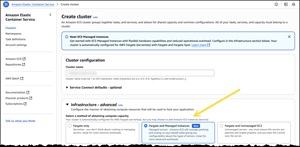 [Click on image for larger view.] New in the AWS Management Console (source: AWS).
In contrast to Fargate, Amazon's fully serverless container compute service mentioned above, Managed Instances offers EC2-level hardware control and pricing flexibility where Fargate offers complete abstraction of the underlying compute hardware, with specific differences including:
- Infrastructure visibility - Fargate hides all infrastructure, while ECS Managed Instances runs on EC2 that AWS manages for you.
- Control - Fargate automatically picks everything, but ECS Managed Instances lets you choose instance types, architectures, and attributes.
- Cost model - Fargate charges per task, while ECS Managed Instances uses EC2 pricing plus a small management fee.
- Resource sharing - Fargate runs each task in isolation; ECS Managed Instances can run multiple tasks on the same instance.
- Flexibility - Fargate supports fewer customization options, while ECS Managed Instances supports GPUs, ARM, and other EC2 capabilities.
Also, AWS's list of key features in documentation note another difference with Fargate:
- Select specific EC2 instance types to meet your application's requirements, enabling access to specialized hardware capabilities such as GPU-accelerated compute, specific CPU capabilities, and large memory sizes.
- Optimize resource utilization and cost with multiple tasks on a single instance by default, unlike Fargate which runs each task in its own isolated environment.
- Ensure security compliance and regular patching with a maximum instance lifetime of 14 days, after which tasks are automatically migrated to new instances.
- Enable advanced networking and system administration functions within containers using privileged Linux capabilities, including CAP_NET_ADMIN, CAP_SYS_ADMIN, and CAP_BPF.
So basically the service is the middle ground between Fargate (easy but limited instance options) and self-managed EC2 (full control but lots of operational work). You pick the hardware you need, AWS handles everything else--patching, scaling, maintenance, optimization.
"Amazon ECS Managed Instances is available today in US East (North Virginia), US West (Oregon), Europe (Ireland), Africa (Cape Town), Asia Pacific (Singapore), and Asia Pacific (Tokyo) AWS Regions," AWS said. "You can start using Managed Instances through the AWS Management Console, AWS Command Line Interface (AWS CLI), or infrastructure as code (IaC) tools such as AWS Cloud Development Kit (AWS CDK) and AWS CloudFormation. You pay for the EC2 instances you use plus a management fee for the service."
About the Author
David Ramel is an editor and writer at Converge 360.