News
Amazon Repeats as a Leader in AI Code Assistants Report
In the newly released Magic Quadrant for AI Code Assistants report from research firm Gartner, Amazon has been named a Leader for the second consecutive year.
The recognition is seen by Amazon as a validation of Amazon Q Developer's commitment to innovation and customer experience, with the company saying it enhances productivity across the software life cycle with AI-driven code generation, transformation, vulnerability scanning, and agentic capabilities, particularly for Amazon Web Services (AWS) environments.
The report notes that Amazon demonstrates innovation by making its AI capabilities available across multiple integrated development environments (IDEs), terminals, and DevSecOps platforms, including integrations with GitHub and GitLab. The company also pioneered specialized agent solutions and has invested in automated reasoning. The Gartner report includes "cautions," and for Amazon Q Developer, these include business model complexity that may make cost planning challenging and the lack of fully defined pricing for some components. The report also notes that the product is deeply optimized for AWS-native services, offering fewer features for non-AWS environments, which could increase switching costs.
"This recognition highlights for us Amazon Q Developer's commitment to innovation and delivering exceptional customer experiences," said Amazon's Brian Beach in a Sept. 19 blog post. "We believe this Leader placement showcases our rapid pace of innovation, which makes the whole software development lifecycle easier and increases developer productivity with enterprise-grade access controls and security."
The AI Coding Assistant Market
While the evaluation of Amazon Q is a key point of interest for the AWS audience, the broader AI coding assistant market is also evolving rapidly, according to Gartner, with various participants competing for market share. As more organizations adopt AI-driven tools to increase developer productivity, the competitive landscape is likely to change, creating both challenges and opportunities for established and new vendors. The report states that "The Al code assistant market continues to burn hot as rapid innovation and intense competition is fueled by disruptive advances and new entrants."
Gartner evaluated providers on their Ability to Execute and Completeness of Vision, with Amazon positioned alongside GitHub, Cognition (Windsurf), GitLab, and Google Cloud in the Leaders quadrant.
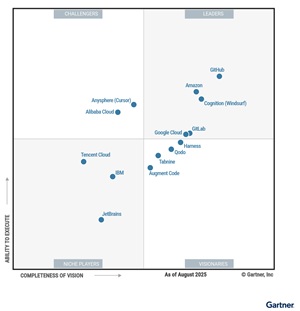 [Click on image for larger view.] 2025 Magic Quadrant for AI Code Assistants (source: Gartner).
For comparison, here's last year's Magic Quadrant for AI Code Assistants:
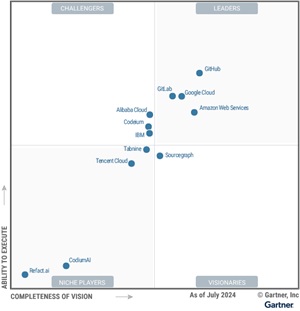 [Click on image for larger view.] 2024 Magic Quadrant for AI Code Assistants (source: Gartner).
Strategic Planning Assumptions
Gartner anticipates increased enterprise adoption of AI coding assistants. The report predicts that "by 2027, 80% of software engineering leaders will consider prompt (or context) engineering a highly important skill to deliver software that meets the business needs of their organizations, up from 20% in 2024."
It also forecasts that "by 2028, 90% of enterprise software engineers will use Al code assistants, up from less than 14% in early 2024."Gartner collectively expects "a 30% productivity gain in software development" across enterprises through 2028 as a result of implementing multiple AI tools throughout the software development lifecycle.
Market Definition and Core Capabilities
Gartner defines AI code assistants as tools that generate and analyze software code and configuration with the use of foundation models such as large language models and program-understanding technology. Developers use these tools for tasks such as generating, analyzing, debugging, testing, refactoring, documenting, translating, and reviewing code.
The tools also aid in searching dependencies, updating libraries, understanding codebases, and reviewing commits.
These assistants integrate with various tools, including IDEs, terminals, chat interfaces, and project management tools. Some can be customized to an organization's specific codebase and documentation. Mandatory features now include context-aware multiline completion, unit test and documentation generation, and broad language and framework coverage. Other mandatory features are enterprise context awareness, an IDE-integrated conversational chat interface, assurances that base models are not trained on customer code, and enterprise administration controls.
Common differentiators among vendors include multifile edits from chat, code quality scanning, vulnerability detection, and terminal command completion. Other differentiating features include enterprise fine-tuning on proprietary data, developer intent prediction, specialized agents for complex tasks, and support for multiple natural languages.
Guidance for Enterprise Adoption
For enterprise adoption, Gartner suggests that software engineering leaders create a cross-functional task force encompassing engineering, architecture, security, and legal to assess, pilot, and govern the implementation of AI assistants. After narrowing down vendors using the Magic Quadrant analysis, organizations should conduct pilots and measure results with frameworks such as DORA and SPACE to track performance, activity, collaboration, and efficiency.
A recurring challenge is adoption friction, with Gartner noting that "often, less than half -- and sometimes fewer than a third -- of purchased licenses see active use after several months." To address this, the report recommends role- and team-specific training, peer learning, and collaborating with developers in the tool selection process to align with their daily needs. Gartner also points out a skills-experience paradox for junior developers and recommends structured upskilling so that AI enhances, rather than replaces, fundamental software engineering skills.
Market Overview
Gartner estimates the 2025 AI code assistant market to be worth $3.0 billion to $3.5 billion, with rapid growth accompanied by volatility driven by competitive pressures. The report notes that vendors are increasingly pursuing vertical integration and proprietary model development to lessen dependency risks. Productivity expectations are being adjusted.
While early claims suggested 30%-50% productivity gains, Gartner's survey data indicates that "42% [of] engineering staff report productivity gains of only 1% to 10% due to Al, while an additional 12% report no gains at all." Gartner concludes that improvements to date have been incremental, with more significant gains anticipated as assistants become more integrated across the software development lifecycle.
Key Trends Shaping the Space
Enhanced contextual awareness is a primary differentiator. Innovation has moved from raw model size to the ability to dynamically surface relevant context from code repositories, IDE state, and broader SDLC data.
In tandem, agentic technologies are gaining prominence, with agents embedded in AI-native IDEs and plug-ins to automate and delegate complex tasks. These changes support a broader shift from simple plug-ins to AI-native or standalone IDEs and comprehensive enterprise-grade solutions. Organizations are increasingly requiring deployment flexibility, administrative controls, and robust measurement for adoption, productivity, and ROI.
While Gartner typically charges for its reports, this and many Magic Quadrant reports are available for free from evaluated vendors who are granted permission to provide complimentary editions, which can be found with a simple web search.
About the Author
David Ramel is an editor and writer at Converge 360.