News
Cloud Giants in GenAI 'Coopetition' Says Infrastructure Spending Report, Led by AWS
Being first in the cloud a couple decades ago, Amazon Web Services (AWS) has since maintained its cloud computing lead against all comers, perennially outpacing competitors in both innovation and market share, those primarily being Microsoft Azure and Google Cloud. A new report from Canalys, now part of Omdia, shows that things have remained the same. More interesting is how advanced AI has transformed the space and how the hyperscalers are responding.
Meanwhile, AWS continues to lead in cloud infrastructure spending, with Microsoft and Google growing faster but still well behind in market share. The report also highlights how the three hyperscalers are simultaneously competing and collaborating in the generative AI space, a phenomenon Canalys terms "coopetition."
Cloud Spending Hits $95.3B in Q2
Global spending on cloud infrastructure services reached $95.3 billion in the second quarter of 2025, rising 22% year over year, according to a new report from Canalys. It marked the fourth consecutive quarter of more than 20% annual growth. Demand was driven by AI-related workloads, renewed legacy migrations, and scale-ups by cloud-native companies.
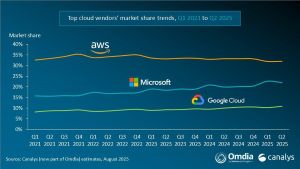 [Click on image for larger view.] Market Share (source: Canalys).
The three leading hyperscalers -- AWS, Microsoft Azure and Google Cloud -- retained their respective positions, collectively accounting for 65% of global spending and seeing combined year-over-year growth of 27%. Azure and Google Cloud posted growth exceeding 30% each, while AWS grew 17% year over year -- steady compared to the previous quarter -- but added more dollars in absolute terms than its rivals.
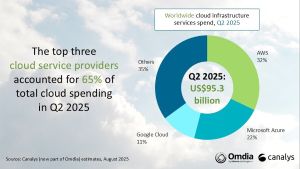 [Click on image for larger view.] Worldwide Cloud Infrastructure Spend, Q2, 2025 (source: Canalys).
Constraints on Capacity Expansion
While demand surged, the report noted that shortages of power and semiconductor resources have limited the pace of infrastructure buildouts, constraining overall market growth. Despite these constraints, hyperscalers are increasing investments to support AI-driven workloads. Microsoft plans about $80 billion in infrastructure spending this fiscal year, while Google raised its 2025 capital expenditure target from $75 billion to $85 billion. AWS has projected its 2025 total spending to exceed $100 billion.
AI Competition and Cooperation
The report highlighted how hyperscalers are simultaneously competing and collaborating in AI. "'Coopetition' has become the norm in the generative AI landscape: vendors compete on model advancement and product capabilities even as they collaborate on compute capacity and model distribution," said Rachel Brindley, senior director at Canalys.
She noted that Amazon Bedrock aggregates models including Anthropic's Claude and OpenAI's GPT, while OpenAI has added Google Cloud to its compute network to boost capacity. Azure AI Foundry and Google Vertex AI are also expanding their rosters of proprietary and third-party models. This multi-model approach aligns with changing customer demand, which, according to Canalys Senior Analyst Yi Zhang, is shifting "from a primary focus on availability and ease of use to a greater emphasis on flexibility and fit-for-purpose model choice."
AWS Maintains Market Lead
AWS held 32% of the global cloud infrastructure market in Q2, with 17% year-over-year growth. Its growth has been steady at 17% to 19% annually over the past six quarters. AWS reported a backlog of $195 billion as of June 30, up 25% year over year.
The report provided the following comparative data on the three hyperscalers
| Provider |
Q2 2025 Market Share |
YoY Revenue Growth |
Key Financial Indicator |
| AWS |
32% |
17% |
$195B backlog (up 25% YoY) |
| Microsoft Azure |
22% |
39% |
$80B planned infrastructure spending (FY25) |
| Google Cloud |
11% |
34% |
$108.2B backlog (up from $92.4B in Q1) |
AI initiatives were central to AWS's activity. In July, AWS launched Amazon Bedrock AgentCore and a new "AI Agents & Tools" category on AWS Marketplace, offering more than 800 agents and tools to streamline AI agent deployment and commercialization. In August, it added Anthropic's Claude Opus 4.1 and OpenAI's GPT-oss models to Amazon Bedrock, broadening access to advanced AI capabilities. AWS also announced multi-billion-dollar infrastructure and AI investments in North Carolina, Pennsylvania and Australia.
Definitions and Market Context
Canalys defines cloud infrastructure services as the sum of bare-metal-as-a-service (BMaaS), infrastructure-as-a-service (IaaS), platform-as-a-service (PaaS), container-as-a-service (CaaS) and serverless options delivered over the internet by third-party providers. For AWS customers, this report, published Sept. 9, underscores the dual trends of steady leadership in market share and rapidly escalating AI investment, amid industry-wide constraints on building new capacity.
About the Author
David Ramel is an editor and writer at Converge 360.