News
Observability Research Cites High Cost of Amazon CloudWatch
Amazon Web Services (AWS) leads most hyperscalers and cloud providers on many fronts in surveys and reports of all kinds, but observability isn't one of them according to new research from analyst firm Gartner, which decried the high cost of Amazon CloudWatch as it placed the company in the "Challengers" section of its latest Magic Quadrant report on the space.
Gartner defines observability as the capability of platforms to help organizations understand the health, performance, and behavior of applications, services, and infrastructure -- all by ingesting and analyzing telemetry data like logs, metrics, events, and traces.
"Client feedback, on inquiry as well as on Peer Insights, frequently mention high costs associated with Amazon CloudWatch and other tools," Gartner said in its latest Magic Quadrant for Observability Platforms report, published July 7. "While cost challenges are a common issue in observability, the integrated nature of AWS -- where services can easily push metrics and logs into CloudWatch -- increases the likelihood of unexpected spend. Clients should ensure they are using the appropriate admin tools, such as AWS Cost Explorer and AWS Budgets, and explore the setting for log ingestion frequency and tracing to reduce ingestion costs."
That was one of three "cautions" about AWS, along with commentary on relative weakness in multicloud workload support and marketing strategy. On the plus side, "strengths" included AI innovation, customer experience and the ecosystem.
Added up, those observations on AWS observability led Gartner to place the company in the "Challengers" quadrant, where it also placed Microsoft, another of the "Big 3" hyperscalers. Google didn't make the cut.
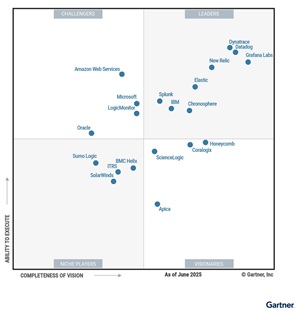 [Click on image for larger view.] Magic Quadrant for Observability Platforms (source: Gartner).
Here's what makes a challenger:
Challengers demonstrate broad market reach and large observability platform deployments. Vendors in this quadrant typically have strong execution capabilities and a significant sales and brand presence garnered from the company as a whole, if not directly from its observability-related activities. Some vendors previously may have been among the top performers in the market and, thus, offer broad product portfolios. Challengers may be transforming their product offerings and market focus. In some cases, their offerings are positioned as elements of a larger solution that may even extend beyond the boundaries of ITOM.
"Amazon Web Services (AWS) is a Challenger in this Magic Quadrant," Gartner said. "Its observability solution is centered on Amazon CloudWatch, which is a suite of tools for metrics, logs and events, and other telemetry types. Additional AWS components include AWS X-Ray for distributed tracing, Amazon OpenSearch Service for log analysis, Amazon Managed Service for Prometheus and Amazon Managed Grafana. This set of services is part of AWS Cloud Operations, which also includes governance and financial management. AWS customers and operations are geographically distributed. Its clients are organizations of all sizes. AWS releases and announces product updates regularly."
Here's how those strengths and cautions were presented in full:
-
Strengths
- AI innovation: Amazon announced Amazon CloudWatch investigations to help SREs, IT operations and cloud engineering teams rapidly diagnose, troubleshoot and remediate operational issues. Additionally, AWS launched natural language query generation for Amazon CloudWatch, AWS CloudTrail, Amazon OpenSearch Service and AWS Config, which will enable a wider audience to interrogate and analyze performance issues.
- Customer experience: AWS provides one of the most comprehensive customer support experiences in the market, with strong custom onboarding support for clients of all sizes, global 24/7 support, vibrant community forums and an industry-leading certification program.
- Ecosystem: The native integration of AWS observability tools such as CloudWatch provides seamless telemetry collection from AWS services with minimal setup. This enables simple configuration through common UIs, unified management and billing via the AWS console, and consistent security through IAM.
-
Cautions
- Multicloud workloads: Amazon CloudWatch is designed and optimized for integration with AWS services. AWS does provide a limited prebuilt integration for ingestion of metrics from Microsoft Azure, other data sources will need to use the OpenTelemetry (OTel) agent, CloudWatch agent or custom configuration. Users will also need to carefully assess charges, such as egress of metrics from other environments, as well as the cost of ingestion into AWS.
- Marketing strategy: Unlike many of the vendors in this Magic Quadrant, observability is not the leading product for AWS. As such, AWS marketing efforts specifically for observability lag the Leaders in this research.
- Costs: Client feedback, on inquiry as well as on Peer Insights, frequently mention high costs associated with Amazon CloudWatch and other tools. While cost challenges are a common issue in observability, the integrated nature of AWS -- where services can easily push metrics and logs into CloudWatch -- increases the likelihood of unexpected spend. Clients should ensure they are using the appropriate admin tools, such as AWS Cost Explorer and AWS Budgets, and explore the setting for log ingestion frequency and tracing to reduce ingestion costs.
While Gartner typically provides research to only paid clients, its Magic Quadrant series of reports are commonly available in complimentary licensed-for-distribution editions from participating vendors, easily found with a quick web search.
About the Author
David Ramel is an editor and writer at Converge 360.