News
AWS Jumps on OpenAI's gpt-oss Open-Weight AI Model Bandwagon
Just days after OpenAI released its first open-weight models since GPT-2, all three major cloud providers--AWS, Microsoft, and Google--moved quickly to make the new gpt-oss series available on their platforms. AWS added gpt-oss-120b and gpt-oss-20b to both Amazon Bedrock and SageMaker JumpStart, aligning with similar rollouts by Microsoft via Azure AI Foundry and by Google through Vertex AI Model Garden. The rapid, near-simultaneous support across the tech industry signals a rare moment of agreement among the cloud giants--positioning OpenAI's open-weight models as a new standard for customizable, enterprise-grade AI.
"Powerful, Flexible Tools"
"Our open weight models help developers--from solo builders to large enterprise teams--unlock new possibilities across industries and use cases," said Dmitry Pimenov, product lead at OpenAI, quoted in an Aug. 6 AWS announcement. "Together with AWS, we're providing powerful, flexible tools that make it easier than ever for customers to build, innovate, and scale."
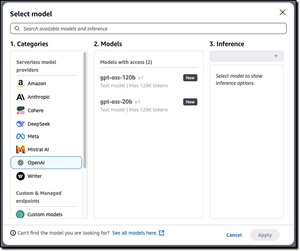 [Click on image for larger view.] Model Selection (source: AWS).
AWS's Danilo Poccia also weighed in on the move: "These open weight models excel at coding, scientific analysis, and mathematical reasoning, with performance comparable to leading alternatives. Both models support a 128K context window and provide adjustable reasoning levels (low/medium/high) to match your specific use case requirements. The models support external tools to enhance their capabilities and can be used in an agentic workflow, for example, using a framework like Strands Agents."
As noted, fellow cloud giants Microsoft and Google also provided immediate support of the new models. While Microsoft made an announcement (see the article, "OpenAI's gpt-oss Powers Hybrid AI Across Azure and Windows"), Google seemingly only planted the new offerings in its Model Garden. A host of other tech heavyweights also offered immediate support, including Hugging Face, Databricks, NVIDIA and more.
Open-Weight vs. Open-Source
A key distinction in the AI landscape is between open-source and open-weight models. Open-source models offer complete access to the model's source code, architecture, and training data, which enables developers to fully inspect, modify, and build upon the foundational elements. Open-weight models, such as the gpt-oss series, provide access to the pre-trained weights--the learned parameters that define the model's behavior--but keep the underlying code and training data proprietary. This approach allows users to run and fine-tune the model for specific applications while the model's creators retain control over its core technology.
Cloud Giants and AI Models
In their strategies, major cloud providers support both open-source and open-weight models to offer a wide range of choices to customers.
For example, AWS, in addition to adding the gpt-oss models, offers a broad selection of other models on its platforms. As the AWS blog post states, this includes "open weight model providers such as DeepSeek, Meta, Mistral AI, and others."
Microsoft, while a key partner for OpenAI's exclusive models, has integrated the open-weight gpt-oss models into its Azure AI Foundry and Windows AI Foundry. This allows developers to run and customize the models on cloud, edge, and client devices.
Similarly, Google Cloud's strategy involves positioning its Vertex AI Model Garden as a platform that hosts a diverse set of models, including its own open-weight Gemma series. This approach allows Google to "attract AI developers and startups" by providing an infrastructure that supports various models from different providers.
"Open weight models are an important area of innovation in the future development of generative AI technology, which is why we have invested in making AWS the best place to run them--including those launching today from OpenAI," said Atul Deo, director of product, AWS. "The addition of OpenAI as our newest open weight model provider marks a natural progression in our commitment to bringing cutting-edge AI to organizations worldwide, and the unmatched size of our customer base marks a transformative shift in access to OpenAI's advanced technology."
About the Author
David Ramel is an editor and writer at Converge 360.